- Events in Ukraine have accelerated the trends to deglobalisation and a new Cold War
- This will justify increased government regulation and control of economic resources
- In this environment, the interests of individuals and corporations are secondary
- The economic costs are high but containable as long as China remains on the sidelines
When we wrote the first of our think pieces on US-China relations (“When Love Breaks Down” 3rd Sept 2018) and then on the changes coming to the US model of corporate capitalism (“RIP Corporate Capitalism: Part I” 7th Feb 2019), we were trying to address two “simple” questions: Where has the global economy been, and where is it going? Our conclusion was equally straight forward: We stood on the cusp of a generational inflexion point with profound economic, and market implications. Unfortunately, as is frequently the case, while gauging the direction of the move is relatively “simple”, the tricky bit is timing. Indeed, at almost every turn, we have been shocked at the speed with which the changes have occurred, and recent tragic events are no exception. Hence, we believe it is an appropriate time to update our bigger-picture thoughts.
Perhaps unsurprisingly, the Russian invasion of Ukraine seems to have prompted other commentators to come to one of the conclusions we reached in our earlier pieces, i.e., we are accelerating towards deglobalisation at an alarming rate, and the Peace Dividend of the last 30 years is dead. If you are too young to remember, we can assure you that when it comes to setting down geopolitical and economic demarcation lines, nothing will be more definitive than a new Cold War, and, judging from Russia’s map of “unfriendly” countries, geographically it looks identical to the old Cold War! At this point, countries are either Friends, Foes, or undecided. PS In the old days, this last group were pawns in the Great Game and frequently where superpowers fought their proxy wars!

Obvious, everything in international relations has just been tipped on its head, but it’s worthwhile spelling out some of the changes. Do you remember when Japan was resolutely anti-nuclear? That’s so last month! Japanese politicians from several parties have recently argued that Japan should review its opposition to nukes. As we wrote in the Japan Update:
“This is an earth-shaking about-face for Japanese politicians. The invasion of Ukraine is having all sorts of effects far beyond the immediate threat to eastern Europe. If Japan decides to share nuclear weapons in Japan with the US, it will greatly alter the balance of power between Japan and its neighbours, including North Korea, South Korea, and China. This is a big deal. We will continue to follow developments closely.”
It’s not just Japan where tectonic changes are being contemplated. Sweden and Finland are discussing applying for NATO membership. Even Ireland, which has been neutral for 70 years, is considering getting “more involved in EU defence policy”. Don’t forget that in war, safety is in numbers, and you have to pick a side!
When it comes to undecided, or using the correct Cold War terminology “non-aligned”, sovereign players, the superpowers are scurrying to corral these countries into their sphere of influence and the incentives will be sweet! Hence, while a lot can still go wrong, the US has offered Iran a new favourable JCPOA deal. Meanwhile, suddenly, the current Venezuelan regime isn’t quite as abhorrent and is talking to US diplomats about oil! The other camp has also been active. The Western press didn’t really cover how the leaders of Argentina and Brazil “popped up” in Moscow just before the war and how neither gave unequivocal support to Washington at the UN. So, it’s probably just a coincidence that both have received a prized quota of now restricted Russian and Chinese fertilizer exports. Right!
In terms of key non-aligned nations, two names stand out in terms of the biggest prizes, India, and Saudi. Thus far, India has so far resisted pressure to pick a side, buying Russian oil not withstanding, and has potentially a lot to gain from taking a middle road. However, the hope is that when push comes to shove, ties to US tech and ongoing animosity towards China will ultimately anchor it in the Western Camp. Similarly, Western fingers are crossed that reports the Saudis are considering accepting Renminbi to settle oil deals is just a negotiating gambit, not the beginning of a significant chasm.
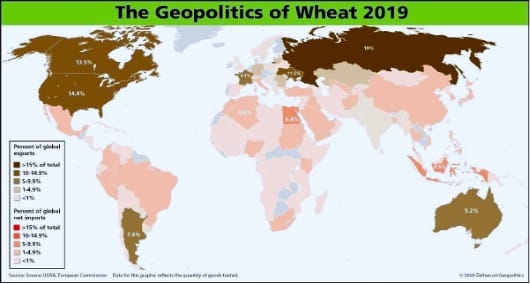
Finally, to Africa, which was ravaged in the old Cold War. In many respects, courtesy of China’s Belt and Road Initiative, it is already in the other team’s pocket. Furthermore, if Russian resources are denied to the West, Africa will become an increasingly “hot” area of competition, especially in regard to food security. This is already a problem in the region, with both Egypt and Algeria announcing restrictions on exports. Don’t forget that the lesson of the Arab Spring is that it doesn’t take much to turn higher food costs into revolution. Therefore, given that both “blocks” have significant resources, especially wheat, at their disposal, there’s a lot to play for in Africa.
Heightened political instability and a world divided into blocks obviously isn’t great for the global economy nor equity multiples. But the implications go way beyond that. Wars are an expensive business and when national security not the invisible hand start dictating the allocation of resources, it’s economic bad news. Its logical conclusion means corporations, investors and individuals also have to pick a side with their interests subjugated to those of the nation-state. No more profit maximisation and, relative to prior trends, both slower growth and higher inflation, which all equates to lower living standards. Yummy…not!
Let us elucidate. In prior work, we have discussed how one of the most profound effects of the Peace Dividend has been globalisation. This has enabled companies to outsource production and lower costs (see chart) while accessing markets of billions of new consumers who previously were on the wrong team. Indeed, both investors and corporations now assume that it is their inalienable right to pursue their own objectives irrespective of national interests. Yet, before 1989 and the collapse of the Berlin Wall, the idea of major Western corporations selling their products, let alone opening factories in the market of a Cold War adversary, would have been anathema for two simple reasons. First, you didn’t share IP with the enemy, and secondly, even if you wanted to, government restrictions stopped you!

Fast forward to events in Ukraine, and the restrictions are back. With the swipe of a pen, sovereign imposed sanctions on Russia have underlined the fragility of wealth based upon globalisation. Investments have been orphaned and businesses destroyed. Financial assets are potentially rendered worthless, and debts are uncollectable. However, thus far the cost has been manageable because while Russia is a big player in specific sectors, it’s only the 11th largest global economy. Those dynamics will change utterly if China defies logic, crosses the line, and supplies the Russians with military equipment. Our clear sense is that the Biden Administration will respond with secondary sanctions, and the gloves will be off!
Even if we avoid the worst-case scenario, it is essential to remember that before recent events, unfettered corporate behaviour was beginning to collide with national interests, especially regarding IP and technology transfer. Four years ago, this led the Trump administration to expand the powers of CFIUS, the Committee on Foreign Investments in the United States (“US-China: When Love Breaks Down” 3rd Sept 2018). Its role is to screen foreign direct investment on the grounds of national security, and similar entities are popping up across the West, growing their remit, and cooperating to shut our enemies out. Post Ukraine, we expect these tools will be improved and widened until they achieve the desired objective.
Perhaps even more startling and arguably more corrosive than governments’ sanctions has been the response of the Western investors and companies to the invasions. With stunning speed, firms have voluntarily cut their business ties to Russia and dumped their assets. If we were to be a little cynical, we’d suggest that given the Russian market’s size, this was cheap way to burnish ESG credentials! However, we worry the newly minted woke executives, who made these decisions, may not have thought through the next logical iteration. This risk was highlighted in a recent CNBC interview with Starbucks’s CFO, who noticeably winced when she was asked, if China overtly backed Russia, would they close their operation there too? Clearly, there is a limit to the E in ESG and we should expect C-suites to use every excuse under the sun to remain in such an important market.
However, what if investors worried about their own reputation, repeat last week’s Chinese stocks dump, and sell their holdings in US firms whose continued activity in China is seen as supporting an adversary? Below is a list of US companies with the highest percentage of their sales in China. What discount should be applied to their multiples?

Before we leave the issue of increased regulation and government oversight, it is essential to understand that it will go well beyond restrictions on companies to invest or move capital. Under the guise of national security, all liberties are threatened and not just in Russia. Governments need to control and monitor the flow of both goods, capital, and information. For example, kiss goodbye to decentralised crypto if it doesn’t serve government objectives, especially if it challenges them. Understand that going forward, you have no more right to visit China than a Russian oligarch has to move his money around.
That brings us to the issue of allocating economic resources, where governments are about to expand their role. As we have discussed, in the last 30-years, deregulation gave companies a free hand to direct capital and labour to pursue maximum profits. Unfortunately, one result is that supply chains have become extended. Covid illustrated the vulnerability of this model and Ukraine will be the final nail in the coffin. This will accelerate the trend to “onshoring”, which firms were already pursuing. However, even before considering the almost insurmountable risk of the fallout extending to China, removing Russia from western supply chains is a herculean task.
Hence, governments are stepping up. One way they can try and help is by corralling the non-aligned nations with mineral resources into their camp. Hopefully, if Latin America goes with the West, it will be an obvious beneficiary of western investment flows. The other role governments will play is bankrolling projects to break our dependence on Russian products. This will take the form of everything from subsidising mineral exploration to the European Commission’s plan to cut Russian gas imports by two-thirds THIS YEAR. The opportunities will be vast but so will the bill. Together, with increased defence spending, Europe has already proposed as much as EUR2tln in joint debt issuance (“Europe: Never Let a Good Crisis Go to Waste” 15th March). Of course, there will be opposition, but to quote veteran US politician Rahm Emanuel:
“You never want a serious crisis to go to waste. And what I mean by that is that is an opportunity to do things that you think you could not do before”.
The upshot is that per our original diagnosis in the first two RIP Corporate Capitalism pieces, we have already seen a peak in the role of the private sector in the economy. Indeed, during the pandemic, the government share of GDP had already risen dramatically and in the process removed the taboo against massive use of fiscal policy. Expect to see more of the same. Government prioritizing defence spending, and, in the case of Europe, the energy transition, will mean that on some level, there must be less in the kitty for other forms of investment and consumption. This is a potential double whammy because it suggests taxes are set to rise materially just as productivity takes a hit.
That backdrop sounds decidedly inflationary, and in that regard, we want to remind you of a piece we wrote at the end of last year (“It’s Always Transitory: A 700-Year History” 12th Nov). In it, we discussed two papers produced for the BoE that concluded that while deflation had been the pervasive trend for hundreds of years, there were notable periods of high prices and real rates. Most importantly, given recent events, those periods tended to be preceded by “geopolitical events or pandemics, i.e. The Black Death, the Thirty Years War, World War II etc.” Between Covid and now war in Ukraine, we think we’ve satisfied those conditions!
To conclude, none of this is great. Recent events have just accelerated the process whereby the world is splitting into clearly defined camps and unwound the benefits of 30 years of Peace Dividend. In the short term, this threatens supply chains and the value of existing investments, while over the long run, it potentially means the exclusion of western companies from key markets and access to resources. In fact, so great are the potential dislocations that unless the current state of affairs is rapidly resolved, governments will have to play a far greater role in the allocation of resources and regulation, whereby, the nation state consumes a far greater share of GDP, and the interest of the individual or corporation are secondary. This is almost the perfect storm for structurally higher inflation and lower corporate profits. If the fallout is mostly restricted to Russia, then markets, even those in Europe, should be able to cope with the immediate effects. However, if for some reason China decides this is the time to throw her all in with Moscow, then all bets are off! We will continue to develop our market thoughts and highlight opportunities as events develop.